
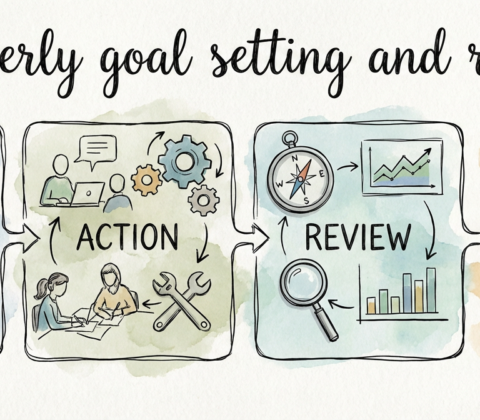
My Messy Journey with Quarterly Reviews (And Why I Keep Getting It Wrong)
The Fantasy vs. The Reality
Let me start with what I thought quarterly goal setting would look like: me, sitting with a perfectly organized planner, sipping coffee that stayed hot, methodically reviewing my accomplishments with the satisfaction of someone who had clearly figured out this whole “intentional living” thing. The reality? It’s currently 11:47 PM on March 31st, I’m hunched over my laptop with three different notebooks scattered around me, and I just realized I completely forgot about two of my Q1 goals until twenty minutes ago.
This is my fourth year attempting some version of quarterly planning, and I’m finally starting to accept that my process looks nothing like the pristine systems I see online. Here’s what I’ve learned that actually matters: the mess is part of the process, not evidence that I’m doing it wrong. Quarterly reviews aren’t about achieving some perfect state of productivity enlightenment. They’re about creating a rhythm that helps me course-correct before I’ve wandered too far off track.
So let me show you what my actual process looks like, including the parts where it completely falls apart and the moments when it actually works.

The Art of the Mid-Quarter Panic Check
I used to think quarterly reviews only happened at the end of quarters. This was my first major mistake. By March 31st, if something wasn’t working, it was too late to do anything about it except feel disappointed and promise to do better next time. Now I’ve built in what I call “panic checks” around week 6 of each quarter.
These aren’t formal reviews. They’re more like emergency triage sessions where I spread out whatever tracking system I was using (spoiler: it has usually changed at least twice by week 6) and ask myself the brutally honest question: “What am I pretending is working that absolutely isn’t?” Last quarter, this led me to abandon an elaborate morning routine that looked great on paper but required me to wake up at 5:30 AM. My night-owl biology was never going to sustain that.
The panic check also forces me to confront what I call “zombie goals” — the ones I wrote down with great intentions but have been essentially ignoring for weeks. Sometimes this means officially letting them go, which feels like failure but is actually just honesty. Sometimes it means figuring out why I’ve been avoiding them. Usually it’s because I made them too vague or too dependent on willpower instead of systems.
What I Actually Track (And What I’ve Given Up On)
I’ve tried tracking everything from daily water intake to the number of books I read to how many minutes I spent on creative work. Most of these experiments lasted about three weeks before I quietly stopped updating my spreadsheets and pretended they never existed. The metrics that have survived multiple quarterly cycles are the ones that either track themselves or require almost no effort to maintain.
Money goals track themselves through bank statements and budgeting apps. Project completion is binary — either I finished the website redesign or I didn’t. Relationship goals that I can tie to specific actions (like “text three friends I haven’t talked to in a while”) work better than vague intentions like “be more social.” The key insight here was realizing that if a goal requires me to remember to track it every day, I’m probably going to forget, get discouraged, and give up.
I’ve also learned to track what didn’t work and why. This feels weird, but it’s been incredibly valuable. I keep a running list of failed experiments: the meditation streak that lasted five days, the exercise routine that was too ambitious, the side project I started but never finished. Instead of pretending these didn’t happen, I try to extract lessons. The meditation failure taught me I need guided sessions, not silent ones. The exercise disaster showed me I need accountability, not just good intentions.
The Quarterly Debrief That Actually Helps
My quarterly review process has become something that looks more like a conversation with myself than a performance evaluation. I sit down with my notebook and work through four questions that have become surprisingly reliable guides.
First: What surprised me this quarter? This question catches things that don’t show up in goal tracking but often matter more than the goals themselves. Like discovering that I do my best creative work in coffee shops, not at my carefully arranged home office. Or realizing that I’m more likely to follow through on commitments when I make them public, even in small ways.
Second: What patterns am I noticing? This is where the messy, incomplete data actually becomes useful. I might not have tracked my energy levels every day, but I can usually spot patterns when I look back at three months of calendar entries and project notes. I consistently crash in energy around 3 PM. I have great weeks when I batch similar tasks together. I get derailed when I try to do too many different types of work in the same day.
Third: What do I need to stop pretending about? This is the hardest question and the most valuable one. It forces me to admit which goals I chose because they sounded impressive rather than because they actually mattered to me. It makes me confront which habits I keep trying to build despite clear evidence that they don’t fit my life right now.
Fourth: Based on everything above, what’s one thing I want to experiment with next quarter? Note that it’s one thing, not five things. And it’s an experiment, not a commitment carved in stone. This framing makes it easier to try something new without the pressure to get it perfect immediately.
Making Peace with Incomplete Data
The biggest shift in my approach has been accepting that I’ll never have complete data about my progress, and that’s actually fine. I used to think that meant my system was broken. Now I think it means my system is human.
There are weeks when I forget to check in with my goals entirely. There are months when my careful plans get derailed by life events I couldn’t predict. There are quarters when I realize halfway through that my goals were completely wrong for where I actually am in my life. None of this is a problem to solve, it’s just the context in which any meaningful goal-setting has to happen.
The quarterly rhythm gives me regular chances to course-correct without waiting for January 1st or some other arbitrary fresh start. It’s short enough that I can try experiments without feeling locked into them forever, but long enough for patterns to emerge and for small changes to add up to something noticeable.
I’m curious about what your experience has been with quarterly planning, especially the parts that didn’t work the way you expected. What have you discovered about yourself through the process of setting goals and then watching how you actually respond to them? What questions have you found most useful when reflecting on a quarter that didn’t go according to plan?
Comments are Disabled