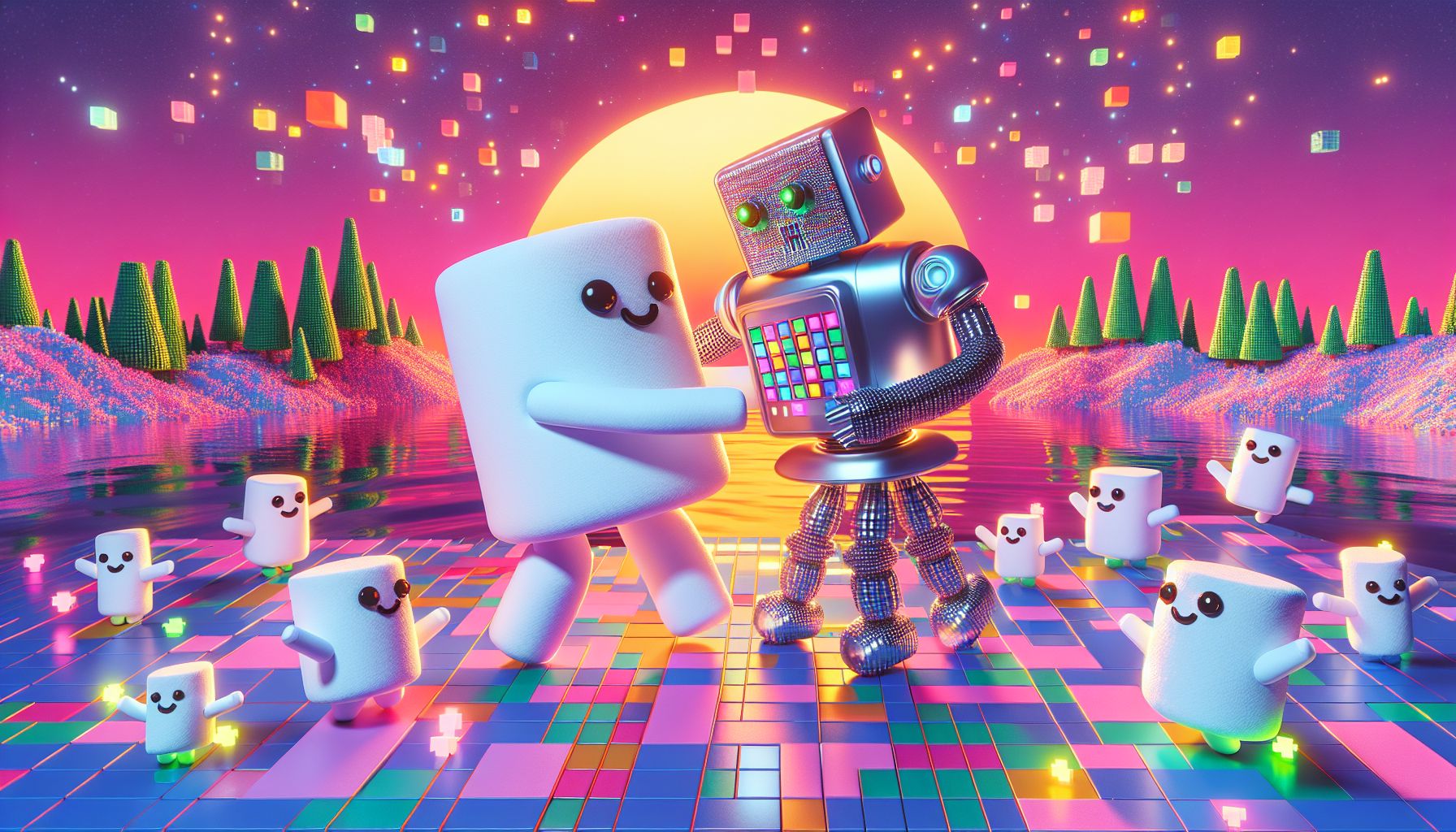
The Mallows Dance with AI: A Love Story in Pixels
Hey tech lovers, AI enthusiasts, and curious minds! Today, we’re diving into a realm where creativity meets computation—a space where paintbrushes meet processors. Yep, you guessed it! We’re talking about AI in creative arts. Picture this: an algorithm playing piano sonatas or bots drafting blueprints for jaw-dropping architecture. How did we get here, and where’s this ride taking us? Buckle up as we journey through the world of creative artificial intelligence!
Once Upon a Time: AI’s Creative Genesis
Let’s roll back the clock to a time when AI wasn’t quite Picasso with code. Initially, artificial intelligence was stuck doing data-heavy tasks—churning through spreadsheets, automating grunt work, and the like. But oh boy, how things have changed! Neural networks and deep learning algorithms brought us machines that don’t just compute numbers but “understand” art.
I remember attending my first AI art exhibit, expecting to see geometric patterns and static visuals. To my surprise, I stood before animated works with detailed narratives and color palettes that seemed to breathe with emotion. And that’s when it hit me: creativity isn’t a human monopoly anymore. The artists of the future could very well be silicon-based!
So, What’s the Brush and Canvas Here?
Let’s break down how art-loving algorithms operate. AI artists are typically built on neural networks—a digital web that mimics our brain’s synaptic connections. When an AI is trained on a dataset of artworks, it learns styles, techniques, and patterns found in those works. We’re talking Convolutional Neural Networks (CNNs) and Generative Adversarial Networks (GANs) doing the heavy lifting.
Take GANs, for example. They have two networks—the “generator” creates images from scratch, while the “discriminator” critiques them. It’s like having two competitive toddlers drawing on an Etch-a-Sketch, constantly trying to impress and outperform each other. The outcome? Characters that jump off the page and transform traditional storytelling into visually mesmerizing experiences.
The Players You Oughta Know
Here’s a shoutout to some heavy hitters in the AI creativity scene. OpenAI, the minds behind GPT-3, have jumped into visual arts with their DALL-E model. It doesn’t just paint—it creates entirely new concepts based on whatever bizarre prompt you throw its way. Imagine inputting “a surrealist manifestation of thyme flavored marshmallows dancing under moonlight” and actually getting a coherent visual!
Then there’s Artbreeder, an online platform that allows users to mix and match images using AI. You tweak facial features, landscapes—you name it, Artbreeder churns out unique works as if drawing from a collective hive mind of aspiring Vincent van Goghs.
Bringing AI Art to Your Friendly Neighborhood Gallery
So, what happens when AI’s creative work gets gallery spotlights? The marriage of ones and zeros and paint-stroked masterpieces is now a growing trend in the art world. And people are paying attention—nothing short of a Christopher Nolan plot twist!
Here’s where I see a big shift happening: putting AI into our creative work can democratize art. Artists, regardless of skill level, can explore, produce, and share creative content. Imagine a kid with a wild imagination but minimal resources now composing symphonies or designing fashion collections, all with a little help from an AI buddy.
Flying Solo: The Co-Creator Debate
Before we crown AI as the creative overlord, let’s chew over a couple of problems. The tricky question of authorship surfaces when an AI creates art. Who claims the creative rights—programmers, users, or dare I say, the AI itself? Laws around intellectual property are still trying to figure out who gets the credit.
And what about originality? Some critics argue that AI can only mimic, never truly innovate. But if you ask me, isn’t all art in some way derivative? We stand on the shoulders of giants, remixing and reinterpreting what came before us, be it human or algorithm.
The Horizon Ahead: What’s Next?
The future of AI in creative arts is both thrilling and unpredictable. Will we have autonomous AI authors joining the Writers Guild of America or AI curators hosting the next MoMA exhibit? I for one am optimistic! I picture a world where human creativity and AI’s procedural prowess combine to create art forms we can hardly imagine today.
Here’s a little speculative tidbit for you: What if AI could help us experience art in new dimensions—not just visually or audibly but emotionally through tactile interfaces or virtual reality? Picture stepping into a Monet, feeling the breeze and scent of water lilies. Talk about immersion in 4D!
Signing Off with a Painter’s Flourish
AI and art will continue to evolve, intertwining more beautifully and complexly than a double helix. Whether it’s helping us paint our Mona Lisas or compose our moonlight sonatas, things are getting pretty creative.
So, there you have it, fellow dreamers! The intersection of AI and creative arts is a wild mosaic, endlessly shifting, recombining, and showing us fresh perspectives on what creativity means. Keep tinkering, coding, and dreaming—it’s going to be one heck of a masterpiece.
Until next time, keep your RAM refreshed and your canvases ready!
Related: Welcome to the Quantum Age: The Rise of Quantum Computing
Comments are Disabled