
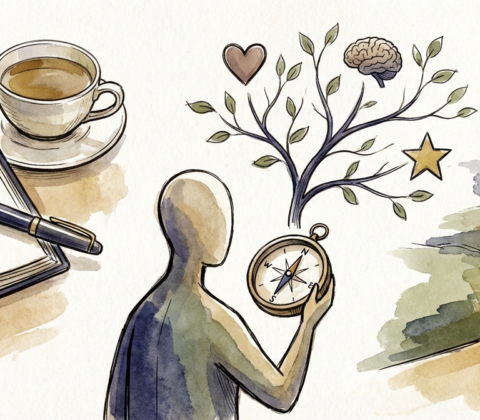
The Thing I Notice When People Start Writing About Their Lives
The Ritual of Putting Pen to Paper
There’s something happening in quiet corners of coffee shops and at kitchen tables before dawn. People are writing by hand again, not for work or school, but for themselves. I see them opening journals with the deliberate care of someone beginning a sacred practice. Their movements are different from the rapid-fire typing we’re used to. Slower. More intentional.
The research tells us why this ritual feels so necessary. Studies show that journaling reduces cortisol levels in our bloodstream while improving our working memory. Our brains literally function better when we process our thoughts on paper. But there’s something beyond the brain chemistry at work here, something that speaks to a deeper hunger for meaning-making when everything feels scattered.
What strikes me most is how this ancient practice has created an entirely modern economy. The bullet journaling movement alone has generated a $200 million market in specialized planners, dot-grid notebooks, and color-coded pens. People are spending real money on the tools of introspection, treating their inner lives with the same care they might give to a hobby or fitness routine.

Making Self-Discovery Accessible to Everyone
Social media has become an unexpected catalyst for deeper personal work. On TikTok, therapy-adjacent journaling prompts rack up millions of views, with creators offering questions like “What would you tell your younger self?” and “Write about a time you surprised yourself.” These bite-sized invitations to reflection are reaching people who might never pick up a self-help book or seek traditional therapy.
Gratitude journaling deserves special attention here. Among all the positive psychology interventions studied in randomized controlled trials, gratitude journaling shows the strongest evidence for lasting impact on wellbeing. People who consistently write down what they’re grateful for don’t just feel better in the moment. They rewire their neural pathways to notice good things more readily.
Yet the real power isn’t in any single technique but in the practice of witnessing your own experience. When we write about our lives, we become both participant and observer, living the story while making sense of it. This dual perspective creates cognitive flexibility that serves us well beyond our journal pages.
Taking Back Control of Our Stories
Something interesting is shifting in how people think about their digital presence. While social media platforms optimize for engagement and reaction, a growing number of people are returning to longer-form personal writing. They’re starting blogs again, crafting essays on Substack and Ghost, treating their own experiences as worthy of sustained attention.
This personal blog renaissance isn’t just nostalgia for the early internet. It’s people deliberately taking back narrative control from algorithms designed to fragment our attention. When someone commits to writing regularly about their life, they’re saying their thoughts deserve more than 280 characters, that their experiences merit exploration rather than just documentation.
The success of thoughtful online voices like The Marginalian long-form writing proves that audiences crave depth. Readers are hungry for authentic reflection, for the kind of meaning-making that can only happen when someone takes time to really think about what they’ve lived through.
Building a Framework for Insight
Good journaling isn’t just emotional dumping onto pages. It requires structure, the kind of framework that transforms random thoughts into genuine insight. Some people find this through bullet journaling’s systematic approach. Others prefer stream-of-consciousness morning pages. Many discover their rhythm through habit-building principles like those outlined by James Clear habit building, treating reflection as a skill that improves with consistent practice.
The most transformative journaling happens when we move beyond simply recording events to examining patterns. Why do certain situations trigger anxiety? What themes keep appearing in our relationships? How do our values show up in our daily choices? These questions require the kind of sustained attention that our distraction-heavy culture rarely rewards but desperately needs.
The process becomes its own teacher. Regular writers learn to notice the difference between writing that merely rehearses grievances and writing that generates genuine understanding. They develop an internal editor that can distinguish between wallowing and processing, between repetitive loops and productive spirals toward clarity.
The Courage to Be Seen by Ourselves
Maybe the most striking thing about committed journalers is their willingness to encounter themselves honestly. They write about their contradictions without trying to resolve them immediately. They record their failures alongside their victories. They treat their inner lives as worthy of the same curiosity they might bring to understanding a close friend.
This practice builds a particular kind of bravery. When we regularly witness our own thoughts and feelings without judgment, we become less afraid of our complexity. We develop tolerance for uncertainty and comfort with the ongoing nature of personal growth. We stop expecting ourselves to be finished products and start appreciating ourselves as works in progress.
The effects extend far beyond personal insight. People who understand themselves clearly tend to communicate more effectively, set better boundaries, and make decisions aligned with their values. They become more interesting to be around because they’ve done the work of becoming interesting to themselves.
What patterns are you noticing in your own life right now? What would happen if you gave yourself permission to explore them on paper, without needing to solve anything or arrive at tidy conclusions? Sometimes the most valuable insights come not from having answers but from learning to ask better questions.
Comments are Disabled